

The best investment committee debates don’t usually start with someone politely telling you that you’re underwriting a corpse.
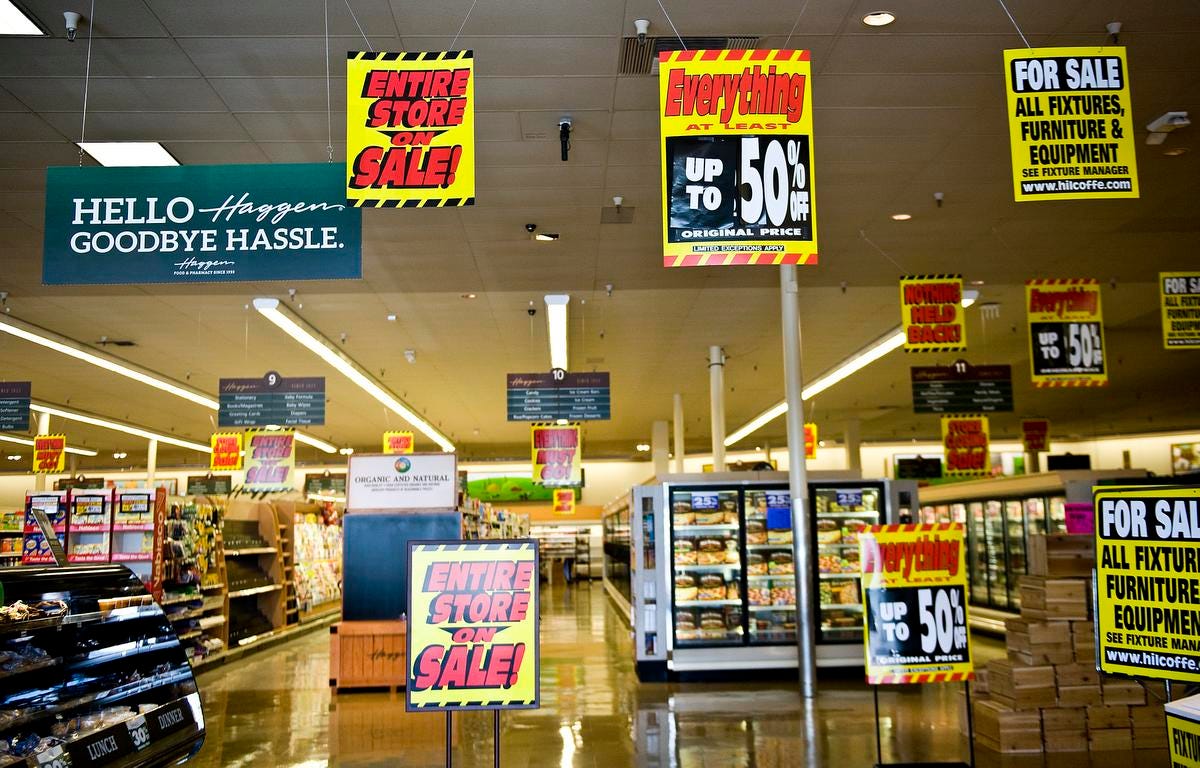
But in a recent committee meeting, that skepticism was the collective initial reaction to what I was pitching. The argument was that the grocery giants are finally finishing off the little guys, and that specialty grocers are a dying breed and the whole independent ecosystem is just a slow-motion liquidation sale. The implication was that if we were underwriting the independent grocer end market, we were essentially underwriting nostalgia. It would be the retail equivalent of buying a rotary phone because you like the mechanical click of the dial.
I get the reflex. If you look at grocery from thirty thousand feet, the “common knowledge” story writes itself: price compression, labor headaches, and the inevitable gravitational pull of Amazon disguised as Whole Foods.
Plus, let’s be honest, independent grocers sound boring. In private equity, “boring” can be a polite euphemism for “how am I supposed to explain this to LPs.” But the more I sit with this deal, the more I realize that “boring” might be a substitute for a story we haven’t interrogated enough yet. Yet my own viewpoint on the deal hasn’t been immune to bias from my own internal narrative.
In my personal life, I hear a steady drumbeat of people (myself included) lamenting that they keep buying more from Amazon. It makes you feel slightly complicit, like you just stole an opportunity from your own community. We talk about wanting better options. We get almost embarrassingly sentimental about the local cheesemonger or the person at the bakery who actually knows your name. While the sentiment is real, it is does not make a useful market analysis, and it’s not a good way to gauge confidence in the future performance of an investment.
The trap is that these anecdotes are presented as “evidence” with the plural of that anecdote being assumed to equate to “data”. It feels like proof because we can all identify with the narratives and they come in neat little packages. But underwriting an end market isn’t the same thing as telling a plausible story about consumer guilt. The first job is to separate the story from the structure and forget entirely about whatever you want to be true, so that we can focus on creating something from scratch, untethered to any influence from selection bias.
The company we were evaluating provides the entire tech stack for these independent grocers: managed services, cybersecurity, payments processing, POS, electronic shelf labels, et cetera. You might equate it to something like the digital plumbing. No customer notices it until it breaks, at which point we all become acutely aware of how critical it is to our seamless day-to-day experiences.
So the real question wasn’t “Do we like grocery?”
It was: “Do we understand the sub-sectors within this market where a store owner with a sustainable competitive advantage will keep paying for technology, keep upgrading, and keep outsourcing complexity?” That is the compounding benefit we’re actually looking for, even if it doesn’t make for a good sound bite.
Some trends start to emerge when you stop thinking about independent grocers as a monolith. When someone says “specialty grocers are dying,” the only useful response is: “Which ones?” There are stores running on 1950s business models that are permanently bracing for impact. They’re fighting a price war against national chains with procurement scale they can never match. They are structurally challenged and they are fighting against basic arithmetic.
But then there is the other category. The ones that don’t try to be a smaller, worse version of a Kroger or a Wegmans. They compete by being specific.
The Ethnic Grocer: Deep community ties and high basket frequency.
The High-End Importer: Where you’ll happily go out of your way to pay $11 for a jar of olives even though they don’t carry any basic paper products.
The Fresh-First Format: Winning on produce freshness and local sourcing that the giants can’t replicate at scale.
This differentiation changes the underwriting entirely. You aren’t asking if “grocery” is growing; you’re asking which operators have a defensible reason to exist. Those are the owners with the margins and the willingness to invest in digital transformation.
At a certain point, the debate can shift. If the market is split, the IT provider’s primary focus is no longer just “selling tech”, but rather customer selection. “Good selection” means targeting the operators who serve high-household-income shoppers and have the stickiness to survive a downturn. It also means having the discipline to say “no.” That can be one of the biggest challenges for a small business. Revenue is seductive, and the “bad-fit” customer is usually the one waving cash with the most desperation, hoping a new POS system will solve a structural business failure.
If the company picks the right winners, they become part of the operating fabric. They benefit from the growth of their customers, tenures get longer, and revenue becomes highly recurring. If they pick wrong, they’re just chasing small fires in a portfolio of struggling stores.
The ending here is ambiguous because, frankly, the discussion is still very much active at my firm. My colleagues might even be reading this. And I don’t want to sound like I’m grading anyone’s homework or claiming my “segmentation” approach is the only path to the truth. What I’ve realized is that underwriting an end market really just means refusing to let the easiest narrative do your thinking for you. It means noticing when you’re using your personal life as a proxy for data. It means treating a market like a collection of individual purchasing behavior decisions rather than one big trendline.
Maybe this end market is sneakily attractive, or maybe the “split” is still too messy to bet on during a cycle. I don’t know yet. But I’d rather have a debate about segmentation than a debate about vibes. And while clarity isn’t the same as confidence, it’s a much better place to start.